
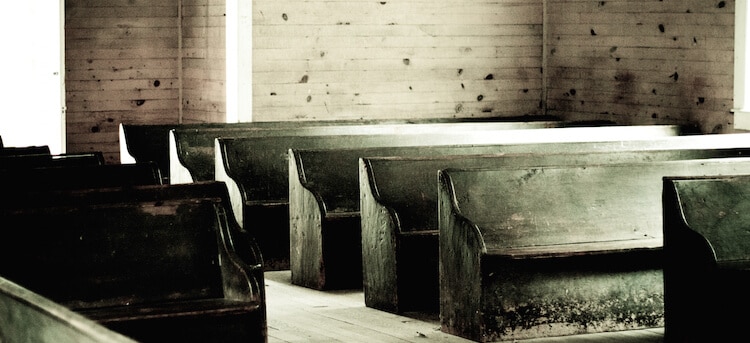

“My church is a mean church!”
I received two emails this week from church members who made that very statement. The members are from two different churches in two different states. One of the churches belongs to a denomination; the other is non-denominational. In both cases the church members made the decision to drop out of local church life altogether.
Yes, I tried to reason with the two members. I told them that no church is perfect. If they had any doubt, I wrote, look at the two letters the Apostle Paul wrote to the church at Corinth. I failed in convincing them to stay in their churches. I pray they will become active in other churches later.
I love local churches. But I have to admit, I am hearing more from long-term members who are quitting church life completely. One member wrote me, “The non-Christians I associate with are much nicer people than the members of my church.”
Ouch. That really hurt.
So, after receiving the second email, I began to assimilate all the information I could find where church members had written me about their “mean” churches. They may not have used the word “mean” specifically, but the intent was the same. I then collected characteristics of these churches, and I found nine that were common. I call these the “nine traits of mean churches.”
- Too many decisions are made in the cloak of darkness. Only a select few members really know what’s going on. The attitude of those elitists is that the typical member doesn’t really need to know.
- The pastor and/or staff are treated poorly. Decisions are made about them without a fair process. Complaints are often numerous and veiled. Many of these churches are known for firing pastors and/or staff with little apparent cause.
- Power groups tenaciously hold on to their power. The power group may be a formal group such as a committee, elders, or deacons. But the group can also be informal—no official role but great informal authority. Power groups avoid and detest accountability, which leads to the next point.
- There is lack of clear accountability for major decisions and/or expenditures. The church has no clear system in place to make certain that a few outlier members cannot accumulate great power and authority.
- Leaders of the power groups have an acrimonious spirit. Though they may make first impressions of kindness and gentleness, the mean streak emerges if you try to cross them.
- A number of the members see those outside of the church as “them” or “those people.” Thus the church is at odds with many in the community instead of embracing them with the love of Christ.
- Many members have an inward focus; they view the church as a place to get their own preferences and wants fulfilled. They are the opposite of the description of church members in 1 Corinthians 12, where Paul describes them as functioning members for the greater good of the body of Christ.
- Many people in the community view these churches negatively. Those on the outside often refer to these churches as “fighting and firing churches.” The community members detect no love for them from these churches.
- Most of the members are silent when power plays and bad decisions take place. They don’t want to stand up to the power group. They are afraid to ask questions. Their silence allows the power abuses to continue.
Are mean churches really increasing in number? My anecdotal information would indicate they are.
What can we do to become a more unified body? How can churches demonstrate more positive impressions to the community? What can we do to hold on to good members who are giving up on local churches altogether? What is your input on these issues? Let me hear from you.
Posted on March 23, 2015
With nearly 40 years of ministry experience, Thom Rainer has spent a lifetime committed to the growth and health of local churches across North America.
More from Thom



240 Comments
Why did you leave out hate, bigotry, judgment, intolerance & racism?
Christ is the head of the church, not the pastor or the board. The only power to be wielded in the church is the power of the Holy Spirit. There are too many spirits controlling people in the churches. If you do not allow the Holy Spirit to control you then you are controlled by ungodly spirits period. All who are born again and have yielded to the working of the Word and Holy Spirit are on the journey. Yes, we are all at different places on that journey, but are we not to prefer others over our selves? In fact, that journey is death to self and Christ living in us. He died as us and the cost of that is to live as Him on this earth. Many churches are not telling the Truth and as a result, many are deceived and hurt in our churches. I believe God is calling many out of the churches who have been hungry and fed from sources other than their church. They are the ones who can and will reach the ones, who are the outcasts, the broken, the desperate, with the love of God. When the church wakes up and redraws the lines that have been blurred, the lines of holiness and purity, then maybe they can reach the unchurched, unloved, unhealed. The church looks entirely too much like the world to make a difference. People are not fooled for long.
This may not be palitable to some, but a major cause for “Mean” churches is because many members are not true Christians!
While experiences of ‘mean’ churches can be devastating – and I have seen my share – I don’t think we should be surprised. Saddened definitely, but not surprised. Because churches consist of flawed leaders leading flawed people. That needs to be acknowledged before progress can be made.
And yet, flawed leaders leading flawed people can be joyful for leaders and profitable for those being led (Heb 13:17).
How? By grace. A less ‘mean’ church culture is a mutual responsibility and, therefore, ought to be a mutual concern. It is not simply a matter of pointing fingers – ‘you need to do your job properly’ or ‘you need to listen and obey me’.
Rather than *pointing out* each other’s burdens, we are called to *bear* each other’s burdens. And that takes grace.
Apologies for preaching – this is the guts of a sermon I preached some months ago on Heb 13:17, which many found helpful. I hope others may also find it helpful.
My fear is that with the ever increasing internal adversity that we seem to be experiencing in our churches today we have to consider the possibility that the body of Christ has been infiltrated by a significant number of unregenerate members just as prophesied by Jude. Also, I am sure there are many factors that have contributed to this problem but I think at the forefront is the lack of the faithful practice of the biblical mandates of believer’s baptism and church discipline. Because the “church gate” has been left open so to speak and there is no accountability of personal holiness allowing sin to reign our churches are experiencing many symptoms including the perception of being “mean”. The only truth I know concerning a reversal of this trend is that “we” can’t fix it ourselves. Only through the purifying power of God can the church become what she is intended to be. May God shed His grace on the body of Christ.
I have researched the subject of the dying local church for sometime now. Can write a long comment on this subject. I live in the bible belt watch churches open and close. My personal church has been struggling with growth for some time now. I agree with all nine points here, But why is it always the congregations fault or the so called leaders deacons trustees etc. Sometimes it may be that the Guy behind the pulpit?
Are they? Yes churches that split will have this reputation,and yes sometimes pastors will go through a rough patch, yes we will get scars, yes churches have “power players”, yes it is biblical, but are they growing in number? I would say it comes back to I am a church member, if there is an air of country club and not church this will happen. Are they growing?
I have pastored these types of churches throughout my 32 years in ministry. One of the first things I learned was to develop a thick hide accompanied by a sharp pair of teeth. Overcoming the fear of insecure people is a huge challenge. I learned not to be intimidated by the “big fish in the small pond.” When you can get to the point as a pastor where you can communicate that they need you more than you need them, you see a lot of the problems go away. Never sacrifice your integrity or self-respect for a “job.” That’s the mentality of a hireling, not a shepherd. I’ve been put out of a couple of churches for this, but God has always taken care of me. I’m amazed at the strength God has given me, but I have learned not to take this personally so that I can continue to love on the very people that God has given me to lead.
You seem to be a wise man, J. C.
Bro. Thom,
Sorry I had to remain anonymous; it’s because of fear that church members might be internet sleuths. But what would you tell a pastor who pastors a church where all nine of these traits are dominant? I’m going crazy!
Desperate for a change,
Anonymous for Nine Reasons
Seriously, I mean as a heart attack, these nine reasons are absolute dominate traits for my church.
I totally understand your need for anonymity. Though I am reticent to respond without more details, it looks on the surface like you need to find another place of ministry. You are in my prayers, friend.
My starting point is that you have no objection to being fired on the spot.
If you can survive financially, or have the faith that God will provide for you, until you have a new position, then do this.
If you either lack the cash, or the faith that God will provide for you, then do not do this.
Once the power elite catch wind of you doing this, the odds are strongly in favour of you being fired on the spot. (Repeating myself, becuase what I describe can be extremely threating to those with power.)
1: What are the current issues that are just under boiling point, in the congregation? The sacred cows, that if it not supported, will result in a hue and cry. The things that if done, will result in a hue and cry. The issues that are, for all practical purposes, hidden, because if brought into the open, will be the equivalent of a volcano going off.
Bring those issues up, front and centre. Have the congregation, as a community, engage them, and resolve them.
2: For twenty consecutive weeks, preach about each of the Ten Commandments, then, for between three and six months, only preach about _basic_ sins:
* Pride;
* Gossip;
* Slander;
* Greed;
* Gluttony;
* Sloth;
* Anger;
* Lust;
* Envy;
No other sermon topics allowed.
All sermons are from the Ten Commandments or one of those venial sins.
Once every three years, revisit this series.
As one example, sermon title is “Gossip is Murder”, and covers Lashon Hara.
3: Get a copy of the _current_ church by-laws. Then, privately, go through them with a good lawyer. (Use a lawyer in a distant town in the same state. I realize that that is tough to do in _The State of Rhode Island and the Plantations of Providence_, where one can walk across the entire state, in one day.) Just tell the congregation you are talking a couple of days off to relax. Do not tell where you are going. Just go. Do not assume that the lawyer will maintain client confidentially. (Ethically, they are supposed to maintian client confidentiallity, but practice is a different story.) Pay the lawyer in cash. When setting up the appointments, use a throw away cell phone and throw away email account. You may, but need not tell the lawyer that, when you talk with him. You need to know precisely what those by-laws allow you to do, and what they do not allow you to use.
If, as frequently happens, nobody has a copy of the current by-laws, then you are up the creek without a paddle. Your only option is to have both the original by-laws, and the most recent version that can be located, and have the lawyer go through both with you, explaining the options.
3: Once you know what those by-laws allow:
a) Hire a forensic accountant to go over the church financials for the last five to seven years. Whilst somewhat underhanded, just tell the congregation that more financial transparency is needed, and that a clear begining is a good way to start. Make _all_ financial transactions of the congregation available on the church website. That includes who gave what. (Verify with a local lawyer that making that information public is legal, in your local legal jurisdiction.) That also includes who authorized what expenditures. (Do not include account numbers. Dates, amounts, who authorized, who was paid, and how much was paid, are essential. Include this for all purchases, even if it is a nickel for pencil from Walmart.) That also includes full disclosure on who is paid what, for the services that they perform for the church. (Verify with a local lawyer that full public disclosure is legal in your local legal jurisdiction. Do not include DOB, SS#, and related data in the accounting software.)
b) Rewrite the by-laws, so that elders and deacons serve no more than one term of four years in one position, and no more than two consecutive terms, and no more than two terms every twenty-four terms. (Rephrased. In every twenty-four year period, a person may serve four years as elder, and four years as deacon, and that is it.) It might be tough to persuade the congregation to vote for this change, but do it. An elected power elite will fight this proposal tooth and nail.
c) Work with a few members of the congregation at a time, getting them to be teachers/leaders of small groups/Sunday School/Bible study classes. As people gain confidence, and graduate, invite others in, and repeat the training sessions. The idea here is to start a training pIf the power clique is elected by the congregation, they will oppose this, perhaps to the extent of firing you.rogramme within the congregation, for people to lead groups, grow, and help others mature spiritually. A corp that has a missionary spirit, and is able to work autonomously. This programme starts as an informal project of yours, preferably with the millenials in the congregation, that are notIf the power clique is elected by the congregation, they will oppose this, perhaps to the extent of firing you. part of the current power clique. (Use _The Training of the Twelve_ as the first book in the training course. Then more recent material for how to teach, lead, etc, in the contemporary world.) Some oIf the power clique is elected by the congregation, they will oppose this, perhaps to the extent of firing you.f the people you train will spin off and form new groups, elsewhere. That is a perfectly acceptable, and, arguably, only desirable outcome.
d) Have all volunteers take a sabattical of at least one year, every four years. During that sabatical, any offers to volunteer, whether or formal or informal, are to be tactfully declined. If there are no volunteers for a position, then the position goes unfilled. If it means cancelling a programme, so be it.
e) All elders and deacons must meet Titus 1:8. Whilst the rest of the criteria in Timothy and Titus are important, the ones laid out in that verse are critical. People seeking either of those positions, must demonstrate how they meet them, at least on a weekly, if not daily basis.
If not allready part of the Congregation By-Laws, change them so that they are.
By “demonstrate”, I mean provide evidence. The applicant for the office must be able to point to specific instances of hospitality, and where they presented sober judgement.
“Holy” implies an active prayer life, and daily Bible study. Remember when Bush was quizzed on what he had studied in the Bible that morning, or the previous evening? That is one question all elders and deacons must be able to instantly answer, and whose answer must change daily.
What counts as hospitality is inviting visitors to a home cooked meal at their abode, not inviting them to Western Sizzler, and picking up their tab. Furthermore, do not confuse an active social life with hospitality.
If people wanting the office don’t provide the evidence, then they don’t qualify, and are not eligible. If you don’t have a full slate of elders and deacons, you don’t have a full slate. If you have no elders or deacons, you have no elders or deacons. This reflects a problem with the congregation at large. A problem that can be fixed, over time.
It will take at least two years, and probably four or five years, for the church culture to change. The change will be very gradual, but visitors who visit every two or three years will notice it.
One potential downside is that the changes may result in the congregation splitting into two, or more factions. The side that wants to keep you, and the side that wants you gone yesterday, if not sooner.
This is not a cure all and not a quick cure for the mean spirits in a church but I think it works over time.
The pastor goes to work immediately to disciple 2 or 3 members of the church and then super encourages and supports them in disciplining more. Pretty soon they will outnumber the mean spirited ones.
In my research of one in my former small church, we kept records of those who completed a prescribed set of discipleship courses and they, with very few exceptions, were the spirit filled and servant leaders in our church. Group disciplining is effective but one on one is the best! It’s the Jesus way!
I also think that all church members would profit greatly by reading the book, I Am A Church Member, (can’t recall the authors name right now :)) to gain a true perspective of what it means to be a church member.
Thanks for the shout out for my book, Tony!
Thank you for writing this! It is very affirming. I am (was) an associate pastor of such a church. I was hired six months ago by a dying church to “bring a fresh perspective,” and I was fired a couple of weeks ago because that fresh perspective aligned precisely with these points and I didn’t align with the powerful inner circle’s control. It wasn’t easy to speak up, but the church’s continuance in sin wasn’t going to be for lack of faith on my part. This article means a great deal to me as my family is now without a church and my children witnessed such betrayal from the church I lead them to trust. We trust God and pray for what He has next for us. Thank you!
I grieve to read your story, Sean. I am praying for you and your family right now.
Thank you! Your prayers are much appreciated! Perhaps this current trend will influence our younger up and coming generation to seek a better, more biblical approach to ministry in their communities.